The Ruskin Monument at Friar’s Crag: Where Lake District Conservation Began
Ten minutes’ easy stroll from the boat landings in Keswick, a low wooded headland pushes out into Derwentwater. This is Friar’s Crag, one of the best-loved viewpoints in the Lake District, and just off the path to its tip stands a simple stone memorial that most visitors walk straight past. It deserves a second look. It honors John Ruskin, the Victorian writer whose ideas, carried forward by his friends, led to the founding of the National Trust – and, through one remarkable young woman, to the protection of much of the countryside you see on our tours today. Friar’s Crag is one of our own favorite places, and here is why.
Ruskin’s first memory
John Ruskin (1819–1900) was the most influential art critic of the Victorian age, the champion of J.M.W. Turner and the Pre-Raphaelites, and a social thinker whose writing still shapes how we think about art, work and the natural world. His earliest memory was of this exact spot. In his autobiography, Praeterita, he wrote:
“The first thing which I remember, as an event in life, was being taken by my nurse to the brow of Friar’s Crag on Derwentwater; the intense joy, mingled with awe, that I had in looking through the hollows in the mossy roots, over the crag, into the dark lake, has associated itself more or less with all twining roots of trees ever since.”
Stand at the end of the crag and you can still see what the small boy saw: Scots pines with their roots knotted over the rocks, the dark water below, and the islands of Derwentwater floating in front of the fells. Ruskin never lost his love for the view. He counted it among the three or four most beautiful in Europe, and anyone who has stood here on a still evening, with the light coming up the lake out of Borrowdale, will forgive him the claim.
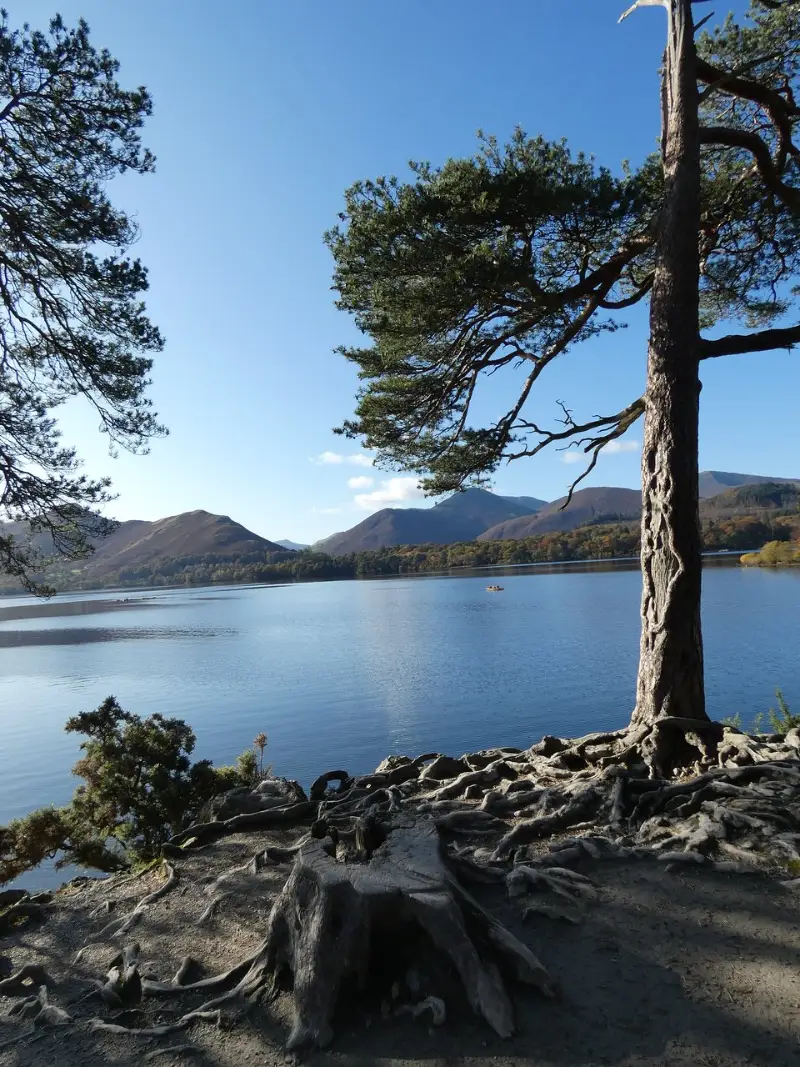
The name, by the way, is older than any of this. Friar’s Crag is said to have been the place where monks set out by boat on pilgrimage to the hermitage of St. Herbert, on the wooded island you can see out in the lake.
From an idea to the National Trust
Ruskin argued, decades before most people agreed with him, that beautiful landscapes and historic buildings were a shared inheritance to be protected, not simply property to be developed or spoiled. Two of the people he inspired took that idea and made it practical. Octavia Hill, the housing reformer, had worked with Ruskin as a young woman and learned much from him. Canon Hardwicke Drummond Rawnsley had been his student at Oxford before becoming the vicar of Crosthwaite, just outside Keswick, where he became the Lake District’s most energetic campaigner against railways, quarries and anything else that threatened the valleys.
In 1895, Rawnsley and Octavia Hill, together with the lawyer Sir Robert Hunter, founded the National Trust for Places of Historic Interest or Natural Beauty. Its first property in the Lake District, Brandelhow Park, bought in 1902, lies on the western shore of Derwentwater, directly across the water from Friar’s Crag. Today the Trust looks after around a quarter of the National Park.
The monument
Ruskin died at Brantwood, his home above Coniston Water, on January 20, 1900. Nine months later, in October 1900, a memorial to him was unveiled just off the path to Friar’s Crag, and the driving force behind it was Canon Rawnsley. It is a plain upright slab of stone among the trees, which seems right for a man who loved the natural world more than grand gestures. It carries a portrait medallion of Ruskin and, beneath it, the opening words of that first memory, carved into the stone a few yards from the place it describes.
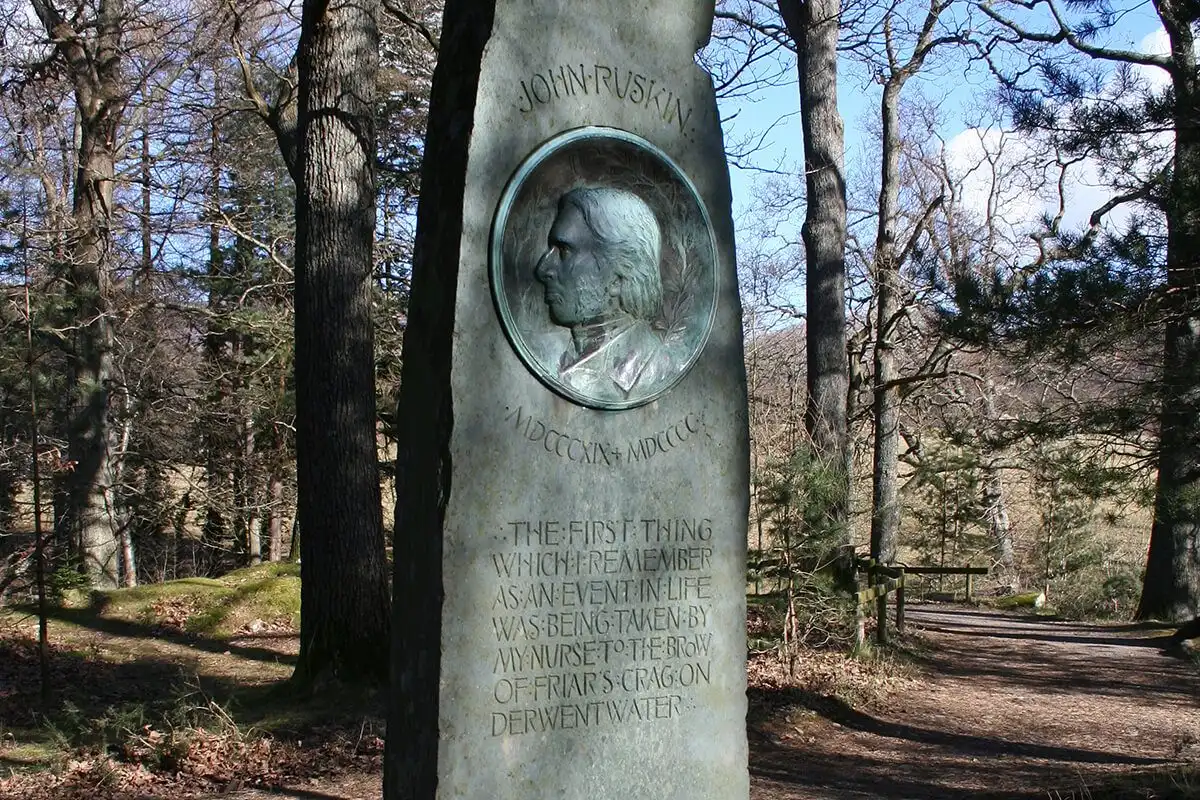
Rawnsley himself is remembered close by. After his death in 1920, Friar’s Crag, Lord’s Island and Calf Close Bay were given to the National Trust in his memory, and a plaque to him is set into a wall beside the Friar’s Crag path. Teacher and student are commemorated within a few hundred yards of each other, on the shore they both loved.
The Beatrix Potter connection
The story does not end with Ruskin and Rawnsley. In 1882, sixteen-year-old Beatrix Potter was on holiday with her family at Wray Castle, near Windermere, when she met the vicar there, a young Hardwicke Rawnsley. He became a lifelong friend and an early encourager of her work, and his passion for protecting the fells and farms of the Lake District made a deep and lasting impression on her.
The Potters later spent many summers on the western shore of Derwentwater, at Lingholm and Fawe Park, and the lake runs through some of her best-loved books. Owl Island in The Tale of Squirrel Nutkin is St. Herbert’s Island, the same island the friars rowed out to; the garden in The Tale of Benjamin Bunny was drawn at Fawe Park; and The Tale of Mrs. Tiggy-winkle is set in the Newlands valley just beyond. When Beatrix Potter died in 1943, she left more than 4,000 acres, including 14 farms, to the National Trust. In a very real sense, a line runs from a small boy staring into the dark water at Friar’s Crag to the protected Lake District landscape of today. You can read more in our guide to how Beatrix Potter saved the Lake District.
Visiting Friar’s Crag
- Getting there: from Keswick town center, follow the signs for the lake and walk past the boat landings. The path to the crag is level and well surfaced, and takes about ten minutes.
- The monument stands just off the path before you reach the tip of the headland.
- Best time: early morning or the hour before sunset, when the lake is often calm and the light comes up out of Borrowdale. Fall color in the oak woods across the water is spectacular.
- Make a day of it: the Keswick Launch boats leave from the landings nearby and circle the lake, and the rest of Derwentwater’s viewpoints are in our guide to Derwentwater, Queen of the Lakes.
See it with us
On our full-day Ultimate Lake District Tour and our winter Ten Lakes Tour, we stop for lunch by Derwentwater near Keswick, and afterward, when the weather allows, your guide may take you for a short stroll along the shore to Friar’s Crag. To follow Ruskin’s story further, our private John Ruskin, Pre-Raphaelites and Arts and Crafts tour visits Brantwood, his home on Coniston Water; our guide to Coniston Water and Brantwood tells that part of the story. All our scenic tours are on the scenic tours page.
This article is part of our Scenic Lake District guides collection, researched and written by our local team. Browse the full library on our Travel Guide Library.